
Stop guessing TradingView Premium pricing and choose the tier your trading really needs
TradingView has become the default charting screen for millions of traders, from casual investors to full-time day traders. But when it’s time to upgrade, the pricing page can feel like a moving target: “special price” banners, monthly versus annual toggles and five plan names that sound alike. If you’re searching for TradingView Premium pricing, this guide explains what drives the number you see and how to decide whether Premium is worth it for your workflow.
TradingView’s own pricing page shows discounted “special price” figures in USD at checkout, with the Essential tier listed at $12.95 per month; the Premium figure shown depends on billing cycle (monthly vs. annual), region and active promotions, so treat any headline number as provisional until confirmed at checkout. Weigh the features you’ll really use, your data needs and the full annual cost together, and confirm anything unclear with TradingView support before you pay.
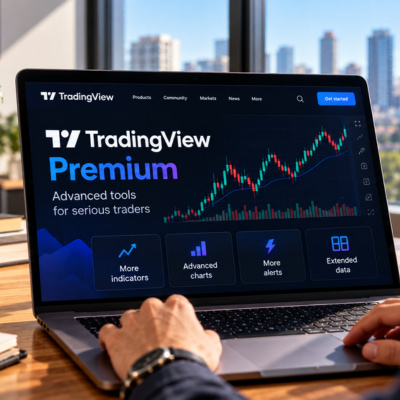
Who upgrades to Premium — and why 🔎
Traders usually consider Premium when a lower tier starts to feel restrictive: not enough indicators per chart, too few alerts, limited chart layouts or not enough historical data for backtesting. The right question isn’t “is Premium the best plan?” but “which specific limit am I hitting, and is Premium the cheapest plan that removes it?”

TradingView Premium price variables and plans 📊
The table summarizes the plan lineup and the factors that change what you’ll actually pay. Treat any promotional number as a snapshot and always read the renewal terms before starting a trial.
| Criterion | Verified point |
|---|---|
| Plan family | Basic, Essential, Plus, Premium and Ultimate |
| Premium price | verify the live checkout and billing cycle |
| Cost variables | tax, market data and promotions |
| Comparison | alerts, charts and indicators |
| Trial | confirm renewal date before activation |
| Use case | match features to actual trading workflow |
TradingView Premium vs. Plus vs. Ultimate: choosing on real needs 🧭
Compare tiers using the same billing cycle and the same set of features you actually rely on. Keep three things in mind: a cheaper-looking plan can become more expensive once you add paid real-time data for the exchanges you trade; a trial period shows you the interface but not how the plan holds up during your busiest market days; and a feature you saw in a video might belong to a higher tier than the one you’re buying.
Before paying, screenshot the checkout page showing the plan, billing cycle, promo price and renewal price, with the date. That’s your reference if the renewal charge doesn’t match what you expected.
| Criterion | Verified point | How to use it |
|---|---|---|
| Need | workflow and measurable outcome | define success first |
| Access | users, roles and MFA | avoid shared credentials |
| Cost | licence, add-ons and labour | calculate total cost |
| Exit | exports and retention | test portability early |
Data fees, renewals and scams around TradingView ⚖️
Your real annual cost is the plan price plus any real-time exchange data you add, applicable taxes and the difference between the promotional first-year price and the regular renewal rate. If you connect a broker, also consider that broker’s own fees, account protections and dispute process — TradingView’s charting subscription doesn’t cover those.
Beware of the scams that orbit popular trading platforms: “lifetime Premium” deals sold on social media, cracked desktop apps, signal groups promising guaranteed profits and anyone asking for your login. Buy only through TradingView’s official site or app.
How to decide on a TradingView plan in one week ✅
List the limits you’re hitting today — indicators, alerts, layouts or data history — and set a maximum annual budget. Start with the lowest tier that removes those limits and, if a trial is offered, note the renewal date on your calendar before activating it.
During the trial, use the plan on real market days and check whether it solves the problem you identified. Before the renewal date, compare the annual cost of that tier with the next one up: if the extra features wouldn’t change your trading, stay where you are.
- Identify the exact limit you’re hitting today.
- Compare Essential, Plus, Premium and Ultimate on that limit.
- Check the live checkout price for your billing cycle.
- Add the cost of any real-time exchange data.
- Note the promo price and the renewal price.
- Mark the trial end date before activating it.
- Avoid “lifetime” or discounted third-party offers.
- Save a dated screenshot of the checkout page.
FAQ ❓
1. Why does TradingView Premium pricing look different every time I check?
- Because the checkout figure depends on billing cycle, region and active promotions. The only reliable Premium price is the one shown in your own checkout on the day you buy.
1. How do I calculate the real annual cost of TradingView?
- Add the plan price for your billing cycle, any real-time market data subscriptions and taxes, and compare the promotional price with the regular renewal rate you’ll pay afterward.
1. What scams should I watch out for with TradingView?
- “Lifetime” subscriptions sold by third parties, cracked apps, paid signal groups promising guaranteed returns and any request for your account password.
1. When should I reconsider my TradingView plan?
- Before each renewal, when a promotion ends, or when your trading style changes and you need more — or fewer — indicators, alerts and data.
1. Where can I find official investor guidance?
- The SEC’s Investor.gov (SEC) portal lists current investment-fraud alerts — worth reading before you trust any trading signal shared on TradingView.
