
Toyota Tacoma 2026 Trailhunter and its off-road technology
Toyota Tacoma 2026 Trailhunter is aimed at drivers who travel far from pavement and often camp along the way. For that use, the most important technology helps the truck move slowly and precisely over difficult terrain.
Overland travel is different from high-speed off-road driving. It rewards torque at low speed, traction management and comfort on long days, rather than suspension built for jumps.
Overland trips also involve long highway stretches to reach the trailhead. Comfort features such as heated and ventilated seats and driver assistance on the highway make those transfers less tiring.
The sections below explain the Trailhunter’s technology, how to use it and what to confirm before ordering, with a focus on the features that matter far from pavement.
What the Toyota Tacoma 2026 Trailhunter brings 🔎
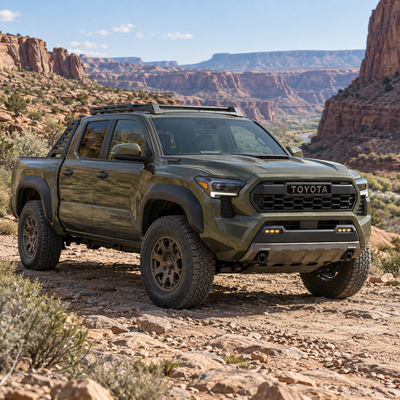
According to dealer specifications, the Toyota Tacoma 2026 Trailhunter uses the i-FORCE MAX hybrid powertrain, a 2.4-liter turbocharged four-cylinder with electric assistance producing 326 horsepower and 465 pound-feet.
The same sources list Multi-Terrain Select, next-generation CRAWL Control, a coil-spring multi-link rear suspension, a high-clearance front bumper and heated and ventilated seats. Toyota Safety Sense 3.0 is standard across the Tacoma lineup, with wireless Apple CarPlay and Android Auto.
Toyota promotes additional overland-oriented hardware on this trim. Confirm the full list on the official build sheet, since equipment details can vary by production period.
How to use the off-road technology for the Toyota Tacoma 2026 Trailhunter ✅
Off-road systems work best when the driver understands them. Before a trip, practise:
- selecting the right Multi-Terrain Select mode for each surface;
- activating CRAWL Control and choosing a speed setting;
- engaging four-wheel drive and low range correctly;
- reading the approach angle with the high-clearance bumper;
- managing the hybrid battery on long climbs;
- loading gear to keep weight low and centerd.
CRAWL Control manages throttle and braking at very low speeds, letting the driver focus on steering. On rocky sections, it reduces wheel spin and keeps the truck steady. It works best when the driver chooses a line carefully and lets the system handle the pace.
Practising in an easy area before a serious trip helps drivers understand how the system responds to different surfaces and speed settings.
Multi-Terrain Select complements CRAWL Control by adjusting traction settings for surfaces such as mud, sand or rock. Choosing the right mode before entering a difficult section is easier than changing it once the truck is already struggling for grip.
The i-FORCE MAX delivers strong torque from low engine speeds, which is useful when crawling over obstacles with a loaded truck. That low-speed pull is one of the main reasons overlanders consider the hybrid.
On long climbs with a heavy load, the hybrid system manages power between the engine and the electric motor. Watching the energy display helps drivers understand how the system behaves and plan steady throttle inputs on extended grades.
For buyers comparing trucks, a look at the value route to factory capability in the Ram 1500 Warlock helps frame the trade-offs.
The figures that define the Toyota Tacoma 2026 Trailhunter 📊
When comparing, the Toyota Tacoma 2026 Trailhunter should be read through torque, drivetrain and off-road aids. Torque determines low-speed control, the drivetrain defines traction and the aids decide how easily the truck handles technical terrain.
Loaded overland gear adds significant weight. Rooftop tents, water, fuel and recovery equipment can quickly approach payload limits, so check the rating on the door jamb label before building out the truck.
Weight distribution matters as much as total weight. Heavy items stored high, such as fuel or water on a roof rack, raise the center of gravity and affect stability on side slopes. Keeping heavy gear low and close to the axles improves safety on uneven trails.
| Item | Specification | What to watch |
| Powertrain | i-FORCE MAX hybrid, 2.4-liter turbocharged four-cylinder | Follow hybrid service guidance |
| Output | 326 horsepower and 465 pound-feet | Strong low-speed torque |
| Transmission | Eight-speed automatic | Fluid on its own schedule |
| Drivetrain | Part-time four-wheel drive | Use low range correctly |
| Off-road aids | Multi-Terrain Select and CRAWL Control | Practise before trips |
| Hardware | Coil-spring rear suspension and high-clearance front bumper | Inspect after rough trails |
Figures reflect dealer specifications as of the verification date. Pricing is excluded because it changes by region and incentive.
Risks and points of attention ⚠️
Three mistakes are common among new overlanders, especially on their first long trips. Overloading the truck with overland gear, which strains suspension and brakes. Using four-wheel drive on dry pavement.
And heading into remote areas without practising the off-road aids. Readers planning retirement savings can review how to open a Fidelity IRA.
Technology for the long, slow miles of the Toyota Tacoma 2026 Trailhunter 🧭
Choosing a Toyota Tacoma 2026 Trailhunter makes sense when overland travel is a real part of your life. With the off-road aids practised, payload respected and the build sheet confirmed, the truck is ready for remote trails.
FAQ ❓
- What powertrain does the Trailhunter use?
- The i-FORCE MAX hybrid, rated at 326 horsepower and 465 pound-feet.
- What does CRAWL Control do?
- It manages throttle and braking at very low speeds so the driver can focus on steering.
- Where can official details be checked?
- On the official Tacoma page at Toyota, with trim specifications.
- Is Toyota Safety Sense included?
- Toyota Safety Sense 3.0 is listed as standard across the lineup.
- Can four-wheel drive be used on pavement?
- Part-time systems should not be used on dry pavement. Follow the owner’s manual.
